

The new UAD 3.6 appraisal guidelines probably weren’t on your mind when you started looking for a home. You were thinking about the kitchen, the commute, and whether your couch would fit. But once you’re under contract, the appraisal becomes a much bigger part of the conversation.
Does the value support the purchase price? Will the report arrive on time? Is the lender going to need anything else?
A major update to appraisal reporting is changing how information about your future home gets collected and presented. The goal is a clearer, more consistent report. Getting there may take some adjustment.
Here’s what’s worth knowing before you’re counting down to closing day.
First, What Exactly Is Changing?
UAD stands for Uniform Appraisal Dataset. It’s the framework used to report appraisal information for mortgages delivered to Fannie Mae and Freddie Mac, which makes it relevant to many conventional home loans.
The older system relied on a collection of fixed forms. The new version, UAD 3.6, uses a flexible report that adapts to the home and the appraisal assignment.
A condo has different details to account for than a brick bungalow. A house with an accessory dwelling unit needs room to explain that space. The new report is built to handle those differences more consistently.
For buyers, the takeaway is straightforward: expect more organized detail about the property your lender is financing.
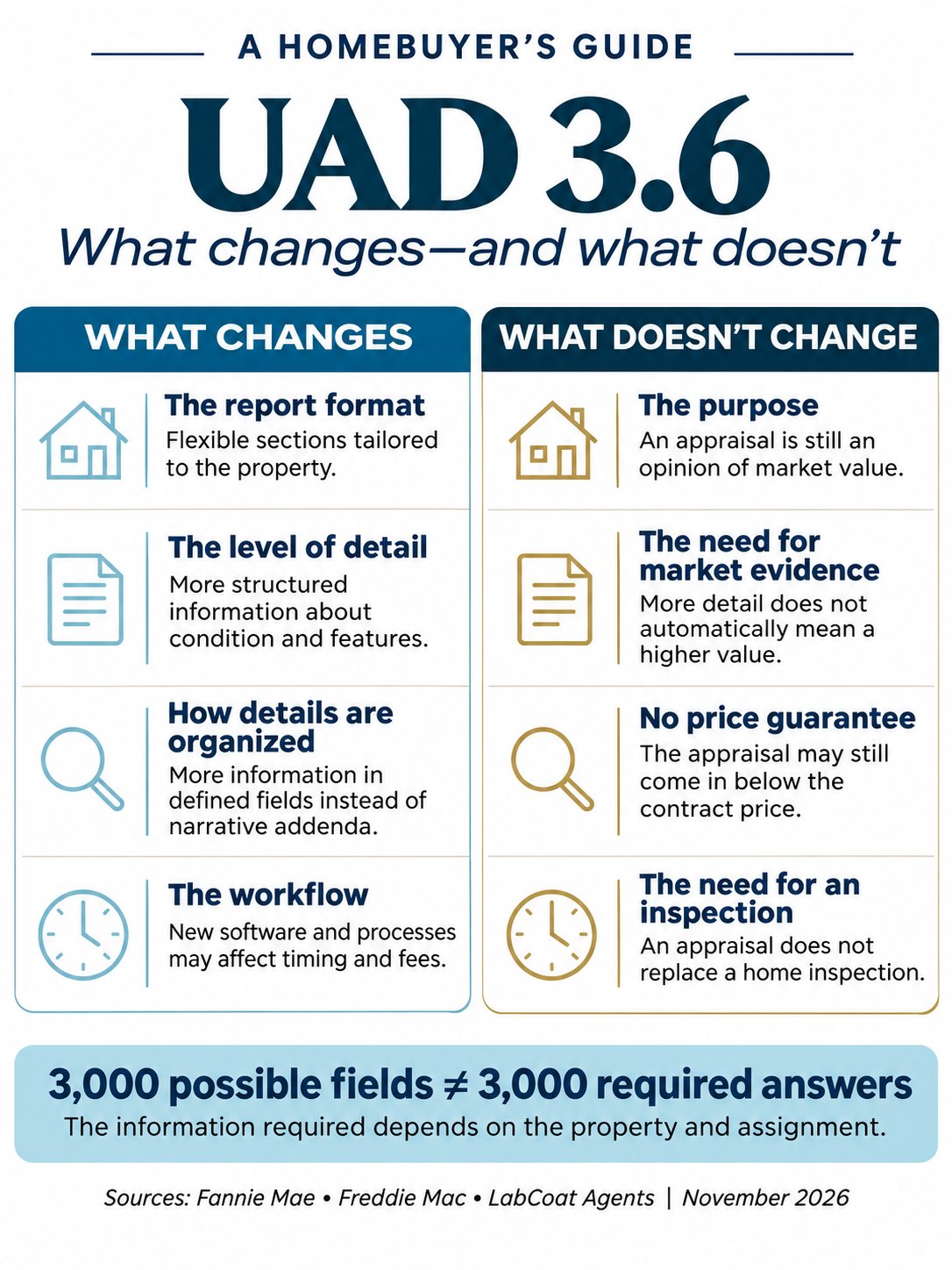
Wait—209 Fields to 3,000?
That number gets your attention. It also needs a little explaining.
The legacy UAD guidance identifies 209 required or conditionally required data points on the traditional single-family appraisal form. Industry descriptions put the redesigned report at as many as 3,000 possible fields.
That’s a big jump—but it doesn’t mean every appraisal requires 3,000 answers.
The information required depends on the property and the assignment. And the old 209-field count never represented every observation, calculation, or judgment involved in an appraisal.
Think of the new system as a much larger menu. The report uses the portions that apply to the home.
Why the Change? Because Homes Have Details That Matter.
“Updated kitchen” can mean freshly painted cabinets and a new refrigerator. It can also mean a complete renovation with new plumbing, cabinetry, and a different floor plan.
Those are very different projects.
Appraisers could explain those differences before, often in written addenda. UAD 3.6 gives more of that information a defined place in the report, making it easier to find and compare.
The redesign includes more specific reporting about property components, interior and exterior condition, and accessory dwelling units.
In St. Louis, where a home might have a century-old original structure, a later addition, and renovations completed across several decades, there can be plenty to explain.
The Upside: A Clearer Picture of What You’re Buying
More organized information can help a lender understand the property and the appraiser’s conclusions. It can also make distinctive features easier to identify and review.
The potential benefits include:
- More useful detail. The report can better distinguish between different conditions, features, and levels of updating.
- Easier review. Clearly labeled information can be easier to locate than a detail buried in pages of commentary.
- Fewer clarification requests over time. As everyone becomes comfortable with the format, consistent reporting could reduce some back-and-forth.
That last point is a goal, not a guarantee. A new reporting system still depends on accurate information and good judgment.
The Trade-Off: A Learning Curve
Appraisers are learning new software and reporting requirements. Lenders are adjusting how they review the results. That creates room for questions, corrections, and occasional delays.
Will your appraisal take longer? It might, particularly during the transition. Ask your lender about current turnaround times rather than relying on what happened during your last purchase.
Will it cost more? It could, depending on the provider and assignment. But there is no universal UAD 3.6 price increase. More possible fields do not automatically translate into a bigger bill.
The useful move is to confirm the estimated fee and timing early, while there’s still room to plan.
More Detail Doesn’t Guarantee a Higher Appraisal
A beautifully documented renovation still has to be evaluated against the market.
Spending $60,000 on a kitchen does not automatically add $60,000 to the appraised value. The same goes for energy-efficient upgrades and other improvements. What buyers are willing to pay—and what relevant sales support—still matters.
UAD 3.6 does not automatically raise or lower home values. It also does not guarantee that the appraisal will match your contract price.
If the value comes in low, your lender and agent can help you understand the financing implications and the options available under your contract. If the report contains errors or overlooks relevant evidence, ask your lender about its reconsideration of value process.
And Yes, You Still Need a Home Inspection
A more detailed appraisal can sound like it covers everything. It doesn’t.
An appraisal develops an opinion of market value for the lending process. A home inspection evaluates the home’s physical condition and helps you understand potential problems.
A longer appraisal report is not a substitute for a home inspection.
When Will Buyers See the New Reports?
The UAD 3.6 mandate began November 2, 2026, based on when a new report is first submitted to Fannie Mae and Freddie Mac’s appraisal portal.
However, lenders using a temporary transition exception may continue submitting older UAD 2.6 reports through May 19, 2027. That means buyers may encounter either format during this period.
Your lender can tell you which applies to your loan. If you’re using a different mortgage program, ask about that program’s requirements.
Refinancing? This Applies to You, Too.
You don’t have to be moving to encounter the new appraisal format. If you’re refinancing a conventional mortgage and your lender requires an appraisal, UAD 3.6 may affect your report, timing, and fee. Some refinances qualify for an appraisal waiver, so ask your lender whether an appraisal is needed and which requirements apply.
What Should You Do Before Closing?
You don’t need to learn the appraisal software. You do want a team that’s paying attention.
- Ask early. What is the appraisal fee, when will it be ordered, and how long is it expected to take?
- Help get the facts together. Your agent can coordinate with the seller’s side to request available renovation dates, permits, and information about significant features.
- Read the report. Check the property description and raise questions about missing or inaccurate information with your lender.
- Keep expectations grounded. A detailed list of improvements helps explain a home. It doesn’t promise a particular value.
A Little Preparation Can Save a Lot of Scrambling
When you’re buying a home, you have enough decisions to make without becoming an expert in appraisal reporting.
At The Dawn Griffin Group, our role is to help you understand what’s happening, coordinate with the people involved, and address questions while there’s time to work through them.
Buying in St. Louis? Let’s talk about your plans—and help you feel prepared for everything between the first showing and the closing table.
Sources and Further Reading
- Fannie Mae: UAD Updates and Transition Resources
- Freddie Mac: UAD 3.6 Frequently Asked Questions
- Freddie Mac: Legacy UAD Requirements and Data Points
- LabCoat Agents: Understanding the Expanded Appraisal Fields
- Consumer Financial Protection Bureau: Understanding Your Appraisal
Requirements and transition arrangements vary by lender and loan program.