
Andrea Durway February 13, 2024
The decision to purchase a home is not just a financial transaction; it’s also a reflection of societal norms, economic conditions, and generational values. Each generation, shaped by unique historical events and cultural shifts, approaches home buying with distinct perspectives and priorities. Let’s explore how pivotal moments in history have influenced home buying trends.
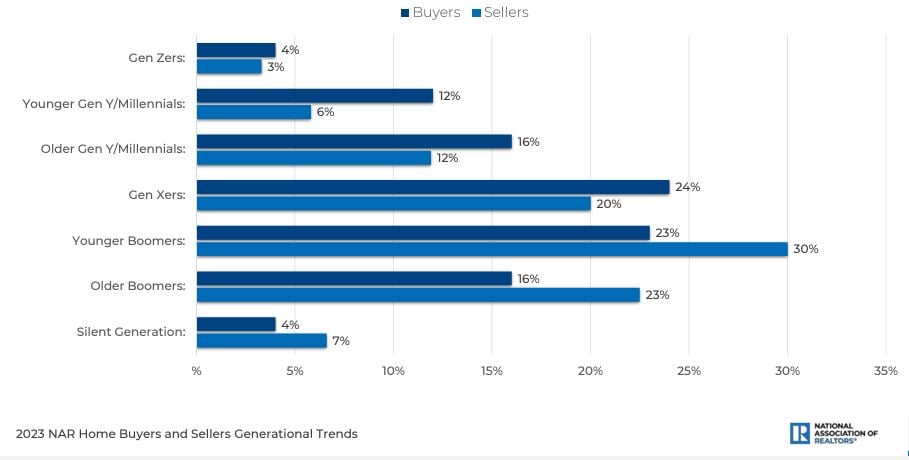
Share of home buyers and sellers by generation. Source: National Association of Realtors
The GI Generation, also known as the Greatest Generation, came of age during the Great Depression and World War II. Their home buying decisions were often pragmatic and centered around stability. Post-war economic prosperity and government initiatives like the GI Bill made homeownership more attainable for many GIs, leading to a surge in suburbanization and the development of the American Dream.
Born during the aftermath of economic turmoil and coming of age in the postwar era, the Silent Generation witnessed the rise of suburban living and the idealization of homeownership. However, they also experienced economic downturns like the recession of the 1970s and oil crises, which instilled a sense of caution and thriftiness. Many opted for modest homes and prioritized financial security over extravagance. Silents were sometimes characterized as trending towards conformity, traditionalism, and caution. However they also formed the leadership of the civil rights movement and 1960 counterculture.
Most baby boomers are children of either the Greatest Generation or the Silent Generation, and are often parents of Gen Xers and Millennials. The Baby Boomers grew up in a time of unprecedented economic growth and suburban expansion. They embraced the suburban lifestyle but also witnessed societal shifts like the Civil Rights Movement and the rise of feminism, influencing their attitudes towards homeownership. Boomers often sought larger homes to accommodate growing families and valued homeownership as a symbol of success and status. Frequently more individualistic that previous generations, with a “forever young” attitude.
Generation X, often dubbed the latchkey generation, came of age during economic uncertainty and cultural change. Many witnessed their parents’ struggles with mortgages and job instability, leading to a more cautious approach to homeownership. They often experience paralysis by analysis. Divorce rates reached 50% for the first time in 1979. Gen Xers were more likely to prioritize work-life balance and flexibility over homeownership, opting for smaller homes or urban living. Born at the birth of high tech, this is the last generation to know what the world was like before smart phones and the internet.
Millennials, the largest generation in history (21.6% of the U.S. population), faced unique economic challenges, including student loan debt, the 2008 financial crisis, and escalating child-care costs. Delayed marriage and child-rearing, coupled with an affinity for urban living and sustainability, shaped their home buying preferences. The 911 terrorist attack was a pivotal event for Millennials. As the first generation to grow up with the Internet, these digital natives are more inclined to prioritize location, community amenities, and eco-friendly features over square footage, driving demand for mixed-use developments and walkable neighborhoods.
The oldest members of Gen Z are entering the housing market amidst technological advancements and societal upheavals. Growing up in the digital age, they value connectivity and convenience. Gen Zers are more likely to prioritize affordability and flexibility in housing options, with preferences for co-living spaces and renting over traditional homeownership. They seek homes equipped with smart technology and eco-friendly features, reflecting their environmental consciousness.
In conclusion, generational differences in home buying trends are intricately linked to historical events, economic conditions, and cultural shifts. While each generation approaches homeownership with its own set of values and priorities, understanding these nuances is crucial for real estate professionals and policymakers to adapt to evolving market demands.
Stay up to date on the latest real estate trends.
Tips, Tools, & Resources
Who to call before the guests arrive, the snow falls, or you head out of St. Louis for the holidays.

Around St. Louis
Comprehensive 2026 guide to shopping small in St. Louis — books, food, vintage, kids, and so much more.

Around St. Louis
Handmade gifts, vintage finds, and neighborhood traditions: 25 markets to plan your holiday weekends around.
Selling A Home
National media exposure, international reach, and a marketing plan built around your St. Louis home.

Real Estate Market News
October 2026 Insights into the local housing market

Around St. Louis
Let a local favorite handle the turkey, the sides or just the pie this year, with every deadline you need in one place.

Buying A Home
How UAD 3.6 affects appraisal costs, timing, and your home purchase

Selling A Home
You make the introduction. We’ll take it from there.

Selling A Home
The questions to ask, and the numbers to check, before you sign a listing agreement
Partner with a team that values honest advice, strategic guidance, and exceptional service. With decades of experience and over 1,000 successful transactions, we're committed to helping you achieve your real estate goals with confidence.
Planning a move? Thinking about selling? Want to talk real estate?

Dawn Griffin Group
3636 S Geyer Rd Ste #100 St. Louis, MO 63127