
Posted by Andrea Durway
Is Native Landscaping a Good Investment for St. Louis Homeowners?
If you’ve driven through Ladue or Kirkwood lately and noticed something different about the streetscape — a cul-de-sac full of wildflowers, Cardinal Flower blazing red in front of a public building, native grasses softening a neighborhood entrance — you’re not imagining it. Native landscaping is quietly transforming some of St. Louis’s most design-conscious communities.
And it’s not a trend that’s peaking. It’s one that’s building.
As a real estate team that spends a lot of time paying attention to what moves markets in this region, we’ve been watching this shift closely. The municipalities embracing it, the buyers responding to it, and the homeowners discovering that what looks beautiful also happens to cost significantly less — it all points in the same direction. Native landscaping has crossed from niche interest into mainstream smart decision.
Here’s what St. Louis homeowners need to know.
Which St. Louis Municipalities Are Embracing Native Landscaping?
One of the clearest signals that native landscaping has arrived is how many area municipalities have formally adopted it — not just in policy, but in visible, well-designed public plantings that show neighbors exactly what’s possible.
Ladue – a regional leader in native landscaping
Ladue has emerged as one of the region’s most intentional leaders. The Native Plant Garden at Ladue City Hall has been maintained by the Ladue Garden Club since 2017, redesigned in 2022, and now features more than 30 carefully chosen native species. As a Tree City USA member, Ladue has made an official commitment to native landscaping education — and the messaging is deliberate: native doesn’t mean messy. It means thoughtful. In one of the St. Louis area’s most design-conscious communities, that framing matters.
Kirkwood, Webster Groves, Olivette and Beyond
Kirkwood transformed a prominent public space into the Pollinator Junction Garden — a thriving, year-round native planting that has become a neighborhood landmark. Webster Groves converted a cul-de-sac into a native garden that neighbors stop to photograph. Olivette launched its Olivette in Bloom initiative across city parks. St. Louis County maintains a native demonstration garden at Queeny Park. South Grand and St. Charles have woven native plants into commercial streetscapes in ways that make the whole district feel more alive.
Beyond individual projects, municipalities including Creve Coeur, Weldon Spring, Chesterfield, and Richmond Heights, have passed ordinances actively encouraging native plants. In 2026, the Garden Club of St. Louis awarded $50,000 in Green Grants — the largest amount in the organization’s history — with recipients including native plant initiatives across the region.
South St. Louis County, in particular, is quietly becoming one of the more active parts of the region for this movement. The infrastructure — the organizations, the nurseries, the community knowledge — is already here.
What Does Native Landscaping Actually Cost?
This is usually where the conversation surprises people.
The assumption is that converting to native plants is expensive or complicated. The reality is the opposite. Native landscaping costs significantly less to install than traditional turf — and the annual savings compound every year after that.
Installation
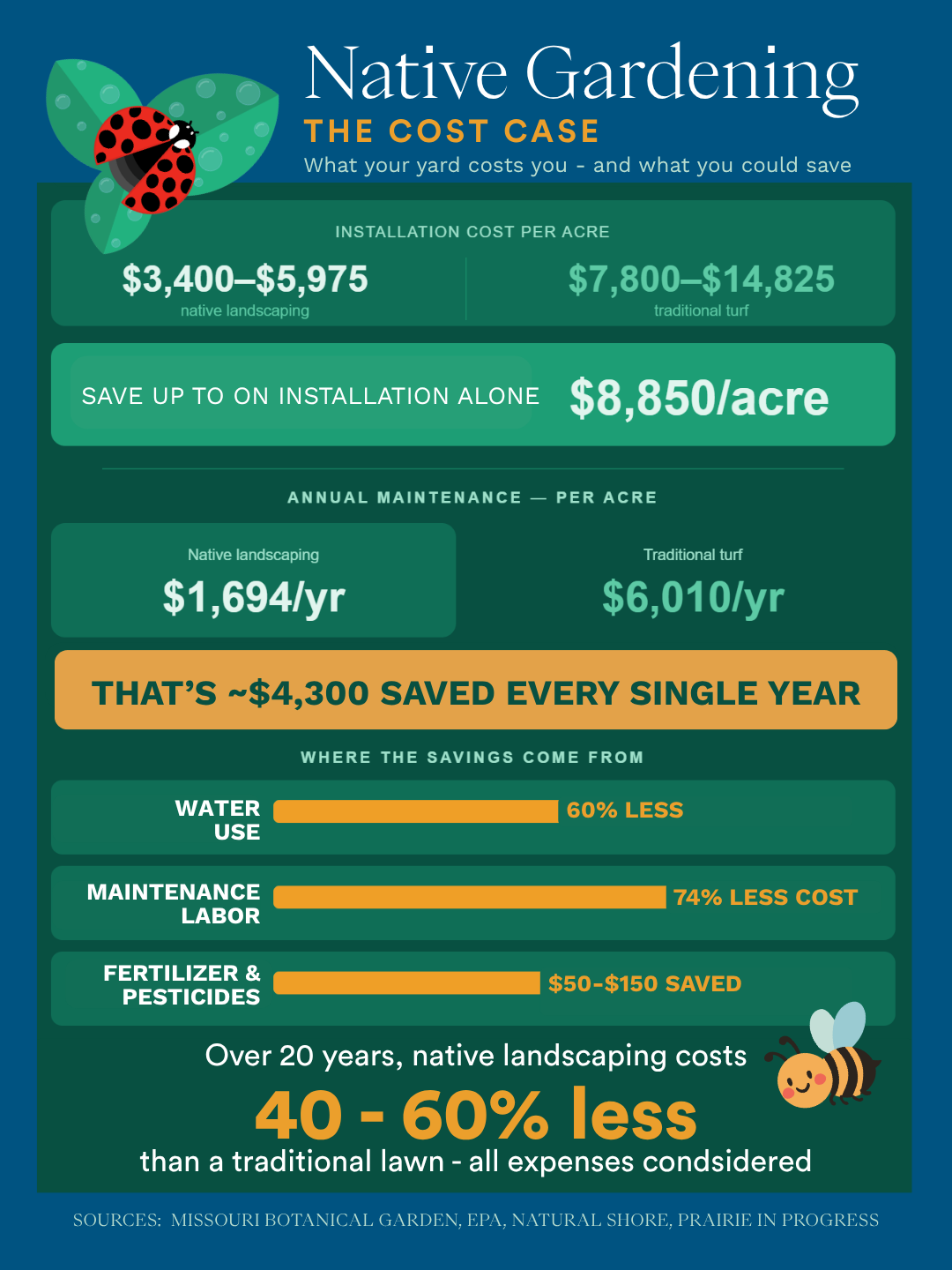
Native landscaping runs approximately $2,500 per 1,000 square feet to install, compared to $3,500 for standard mulched planting beds — and $3,400 to $5,975 per acre versus $7,800 to $14,825 for traditional turf. That’s a potential savings of up to $8,850 per acre before a single season has passed.
Annual Maintenance
Here’s where the long-term case becomes undeniable. Annual maintenance for native plantings averages $200 per 1,000 square feet — compared to $400 for traditional beds, and $1,694 per acre versus $5,550 to $6,471 for traditional turf. That’s roughly $4,300 saved per acre, every year.
Water Bills
Native plants use 50 to 75% less water than a traditional lawn once established. In St. Louis summers, that translates directly to lower utility bills — and the savings grow as irrigation needs drop toward near-zero in mature plantings.
The 20-Year Picture
Over two decades, native landscaping costs 40 to 60% less than a traditional lawn when all expenses are factored in — installation, maintenance, water, fertilizer, and pesticide inputs. The math is not close.
Sources: Missouri Botanical Garden / OneSTL, EPA, Natural Shore, Prairie in Progress
When Does a Native Garden Really Hit Its Stride?
Year three. That’s the turning point almost every native gardener will tell you about.
The first two years, native plants are doing most of their work underground — establishing root systems that can reach 10 to 15 feet into Missouri’s soil. It looks like patience. By year three, those roots are fully set, plants fill in substantially, weeds have been crowded out, and maintenance drops dramatically. What looked like an investment starts looking like freedom.
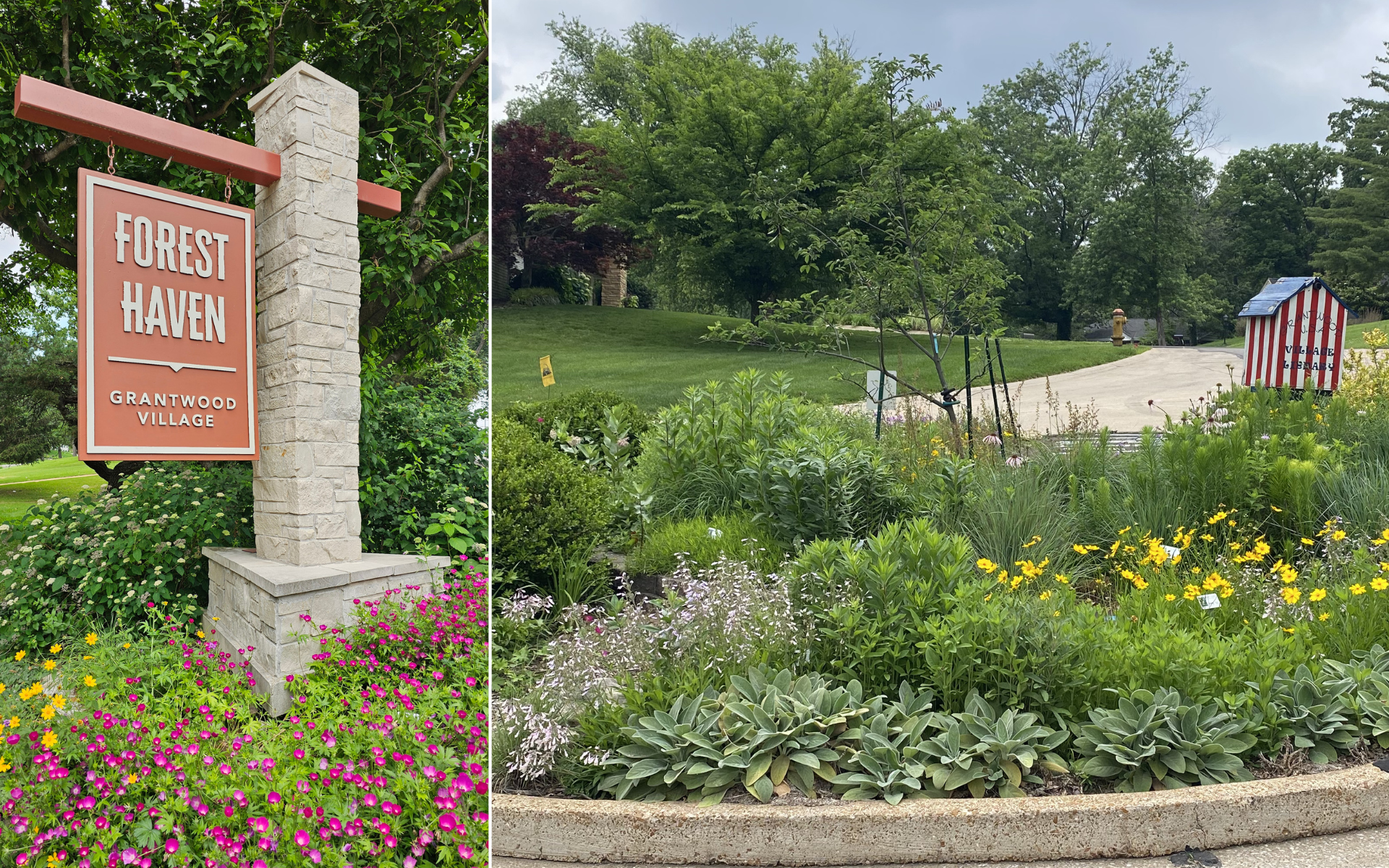
This is why many of the most beautiful native plantings visible across the region right now — the Ladue city hall garden, the Webster Groves cul-de-sac, neighborhood entrance plantings throughout south county — are three to five years old. The maturity is visible. And it’s genuinely impressive.
Does Native Landscaping Help with Curb Appeal and Home Value?
Yes — with one important clarification worth making.
Quality landscaping in general has a well-documented positive effect on home value and time on market. Research from Virginia Tech Extension shows that landscaping improvements add 5.5% to 11.4% to perceived home value. A University of Vermont study found that homes with strong landscaping can command up to 15 to 20% more at resale and sell up to six weeks faster. Investing 5% of home value in landscaping can return 150% ROI at the point of sale.
Native gardens earn those same benefits — when they’re well-designed. That’s the operative phrase. A native garden with structured beds, defined edges, curated plant selection, and seasonal color reads as sophisticated and intentional. It says: this homeowner is engaged, and this home is low-maintenance. That’s a powerful signal to buyers.
What Happens When a Native Garden Goes on the Market?
A recent New York Times article looked at this exact question: homeowners who have converted traditional lawns into native gardens eventually face a moment of truth when it is time to sell. Will buyers understand what they are seeing? Will agents know how to market it? Or will everyone push for sod, mulch, and boxwoods?
The answer was more nuanced — and encouraging — than many homeowners might expect.
In one example from Silver Spring, Maryland, a homeowner had replaced much of his lawn with native trees, shrubs, perennials, and grasses. Before listing, he worked with his real estate agent to make the garden read as intentional rather than overgrown: beds were edged, leaf litter was replaced with mulch for a cleaner showing presentation, and the seller handled weeding carefully so volunteer native plants could remain. The home accepted an offer $20,000 over list before the first open house, and the buyers said the garden was part of the appeal.
That is the key takeaway for St. Louis homeowners: native landscaping does not need to be removed before a sale, but it does need to be presented well.
Defined edges, clear pathways, seasonal photos, plant lists, and simple maintenance notes can help buyers understand that a mature native garden is not a neglected yard. It is a living landscape with lower maintenance, lower water needs, and real ecological value.
The article also highlighted agents who are beginning to market native gardens more intentionally — showing seasonal blooms, mature trees, organic practices, and wildlife value as features of the property. That is where native landscaping can shift from a perceived risk to a genuine selling point.
Buyer Preference for Native Gardening
There is no peer-reviewed study that proves native gardens command a premium over other quality landscaping. What the research does show is that buyer preferences are moving clearly in this direction. A University of Michigan study found that buyers preferred yards with 75% native plantings over conventional lawns — with the conventional lawn ranking last. Consumers in auction research paid a 14% premium for plants marketed as native and non-invasive. Realtors in markets ahead of this curve consistently report that well-designed native gardens have become a genuine selling point.
The value case is strongest when you think about it this way: native landscaping protects and enhances home value through lower ongoing costs, stronger curb appeal, and alignment with where buyer preferences are already heading.
What Are Buyers Actually Looking For in Outdoor Spaces?
Buyer preferences around landscaping have shifted meaningfully — and the numbers reflect it.
The generational picture is particularly striking. Gen Y and Gen Z buyers — now the dominant force in the homebuying market — consistently prioritize sustainability and low-maintenance living. In 2025, 61% of Gen Y buyers increased their gardening budgets; 63% plan to spend more in 2026. These are buyers who want a yard that looks intentional and takes care of itself. A mature native garden delivers exactly that.
Sources: Axiom 2026 Gardening Outlook, National Association of Landscape Professionals
What Are the Environmental Benefits of Native Plants?
The environmental case for native landscaping is real — and it’s one reason buyers increasingly respond to it, not just as an aesthetic choice but as a values signal.
Native landscapes sustain insect populations at six times the rate of non-native plantings, according to the American Horticulture Society. Those insects are the foundation of local food webs — supporting the birds, butterflies, and pollinators that make a yard feel genuinely alive rather than just maintained.
Native prairie species sequester carbon at 1.8 metric tons per hectare per year, compared to just 0.4 metric tons for turfgrass. Deep root systems stabilize soil, filter stormwater, and reduce runoff — a meaningful consideration in south St. Louis County, where heavy rain events and flooding have become recurring concerns in recent years.
A conventional lawn mower pollutes as much in one hour as driving a car 20 miles. Reducing or eliminating mowing has real air quality impact at the neighborhood level. And Americans collectively use approximately 9 billion gallons of water per day on lawn irrigation — native plants, once established, need almost none.
None of this requires a buyer to lead with environmental values. A yard that handles Missouri’s weather better, costs less to maintain, and draws pollinators all season long is simply a better yard.
What Local Resources Are Available for Native Landscaping in St. Louis?
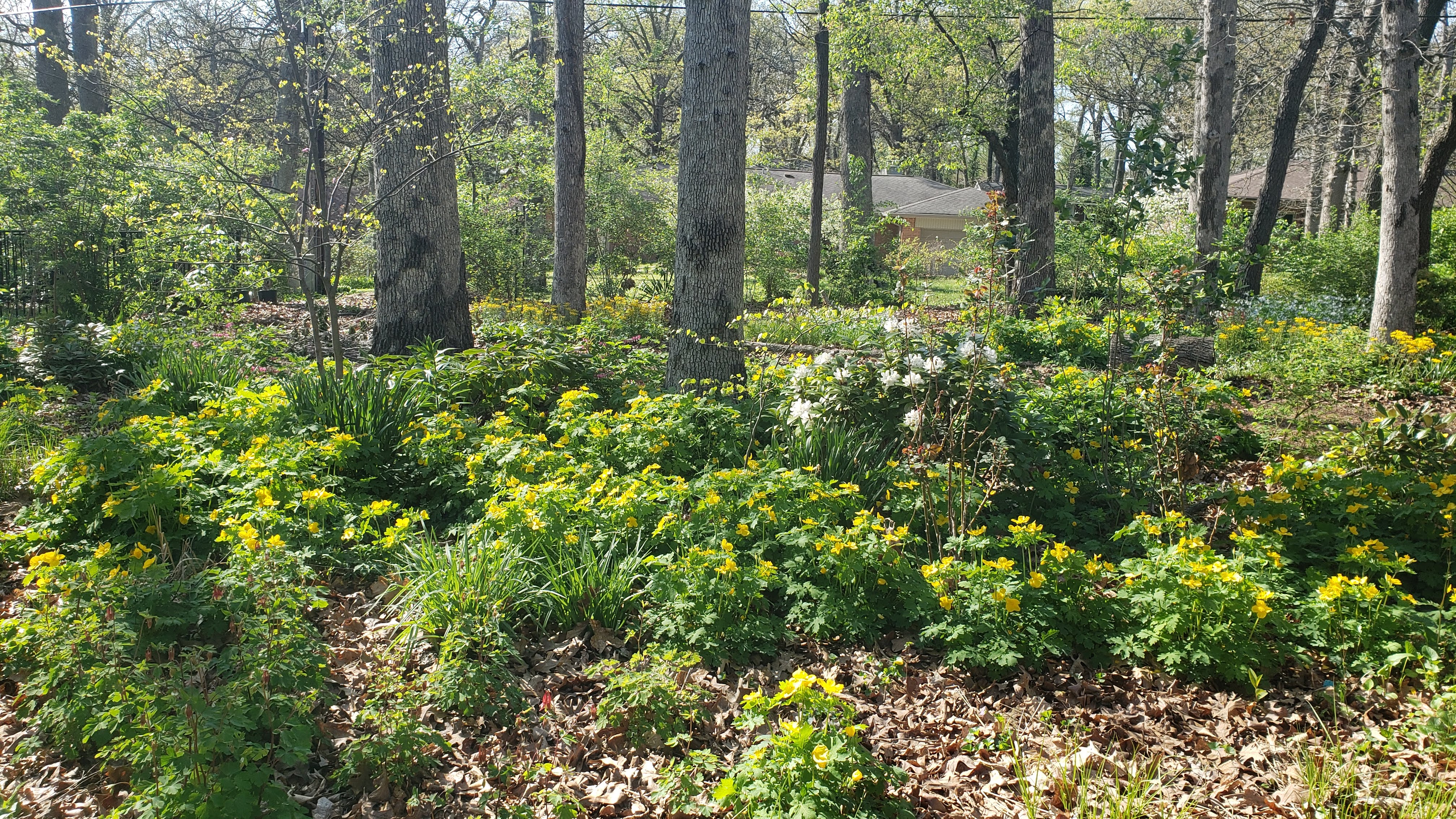
This is where St. Louis homeowners have a genuine advantage. The depth of local expertise and resources here is exceptional.
Grow Native!
Missouri Prairie Foundation’s flagship program, now celebrating 25 years — offers a Native Landscaping Planning Toolkit, a model ordinance that municipalities across the region are adopting, and a directory of native nurseries and landscape professionals calibrated for Missouri’s plant communities. If you’re starting from scratch, this is the first call to make. grownative.org
Wild Ones St. Louis
One of the most respected native plant organizations in the region — and one of the most active chapters of the national Wild Ones network. Their annual Bring Conservation Home garden tour, produced in partnership with the St. Louis Audubon Society, opens private native gardens to the public. The 2026 tour features gardens in Ladue and Olivette. Attending is one of the best ways to see mature, well-designed native gardens in residential settings — and to connect with homeowners who have already done what you’re considering. stlwildones.org
Missouri Botanical Garden
One of the top botanical institutions in the world, right here in St. Louis — offers native plant demonstration gardens, educational programming, and the PlantFinder database for identifying Missouri-appropriate species. missouribotanicalgarden.org
Seed St. Louis
Focuses on community-scale native planting projects across the city and county, with neighborhood-level programming that makes the movement tangible and accessible. seedstlouis.org
Missouri Department of Conservation
Provides free native plant guides, landscape planning resources, and cost-share programs for qualifying projects. mdc.mo.gov
Missouri Wildflowers Nursery
One of the premier native plant nurseries in the Midwest — sells at the Kirkwood Farmers Market, putting regionally appropriate plants within easy reach of St. Louis homeowners. mowildflowers.net
Deer Creek Watershed Alliance
Offers cost-share of up to 75% for qualifying rain gardens and native plantings within the Deer Creek watershed corridor — a significant financial incentive for homeowners in the Ladue, Clayton, Frontenac, and south county areas. Pre-approval is required before beginning any work. deearcreekalliance.org
The Bottom Line
Native landscaping costs less. It looks better over time. It aligns with where buyer preferences are heading. And St. Louis — with the Missouri Botanical Garden, Grow Native!, Wild Ones, and some of the best native plant expertise in the Midwest right here — is one of the best places in the country to do it well.
For homeowners considering any landscape investment, the native case is worth taking seriously. Not because it’s trending, but because the numbers hold up, the aesthetics have matured well beyond the wildflower-meadow stereotype, and the buyers coming into this market over the next decade are going to see a well-designed native garden as exactly what it is: a smart choice.
The yard is part of the story. Make sure yours is telling the right one.
Frequently Asked Questions
What is native landscaping?
Native landscaping uses plants indigenous to a specific region — in St. Louis, plants native to Missouri and the broader Midwest. Because these plants evolved alongside local soils, rainfall patterns, and wildlife, they require far less water, fertilizer, and maintenance than non-native species once their root systems are established, typically by year three.
How much does native landscaping cost in St. Louis?
Installation runs approximately $2,500 per 1,000 square feet for native groundcovers, compared to $3,500 for traditional mulched beds. Annual maintenance averages $200 per 1,000 square feet versus $400 for traditional plantings. Over 20 years, native landscaping costs 40–60% less than a traditional lawn when all expenses are considered. (Sources: Missouri Botanical Garden / OneSTL, EPA)
Does native landscaping increase home value?
Quality landscaping — including well-designed native gardens — adds 5.5% to 11.4% to perceived home value and can reduce time on market by up to six weeks. The strongest value case for native landscaping specifically comes through lower ongoing costs, curb appeal, and growing buyer preference for sustainable, low-maintenance yards. No study directly proves a premium over other quality landscaping, but buyer preference data is moving clearly in this direction.
When does a native garden look its best?
Year three is the turning point. Native plants establish deep root systems in their first two years; by year three, plants fill in, maintenance drops substantially, and the garden largely manages itself. Most of the impressive native plantings visible across St. Louis today are three to five years old.
Which St. Louis municipalities support native landscaping?
Ladue, Kirkwood, Webster Groves, Olivette, St. Louis County, Creve Coeur, Weldon Spring, Chesterfield, and Richmond Heights are among the municipalities that have formally embraced or passed ordinances encouraging native plants. The Garden Club of St. Louis awarded $50,000 in Green Grants in 2026 — its largest ever — to native plant initiatives across the region.
What native plants grow well in St. Louis?
Missouri-appropriate natives for residential use include Purple Coneflower, Black-Eyed Susan, Cardinal Flower, Wild Blue Indigo, Smooth Hydrangea, Big Bluestem grass, Wild Geranium, and Coreopsis. These plants offer color from early spring through late fall. Missouri Wildflowers Nursery (available at the Kirkwood Farmers Market) and Grow Native!’s nursery directory are excellent local starting points.
Are there financial incentives for native landscaping in St. Louis?
Yes. The Deer Creek Watershed Alliance offers cost-share of up to 75% for qualifying rain gardens and native plantings within the Deer Creek watershed corridor — covering much of Ladue, Clayton, Frontenac, and south St. Louis County. Pre-approval is required. The Missouri Department of Conservation also offers cost-share programs for qualifying installations.
Does native landscaping have to look wild or overgrown?
No — and this is one of the most important misconceptions to address. Well-designed native gardens use structured beds, defined edges, and curated plant selection to achieve a polished, intentional aesthetic. Ladue’s city hall demonstration garden was designed specifically to show that native plants can look formal and sophisticated in an upscale neighborhood context. Design quality is what determines how a native garden reads to neighbors and buyers alike.
Where can I learn more about native landscaping in St. Louis?
The best local resources are Grow Native! (grownative.org), Wild Ones St. Louis (wildonessaintlouis.org), the Missouri Botanical Garden (missouribotanicalgarden.org), Seed St. Louis (seedstlouis.org), and the Missouri Department of Conservation (mdc.mo.gov). The Wild Ones St. Louis annual garden tour is particularly valuable for seeing mature residential native gardens across the region.
How does native landscaping affect water use?
Native plants use 50–75% less water than a traditional lawn once established. In St. Louis’s hot summers, that reduction translates directly to lower utility bills — and the savings increase as plantings mature and irrigation needs drop toward near-zero.
The Dawn Griffin Group is a top 0.5% St. Louis real estate team at eXp Realty, specializing in helping buyers and sellers navigate the region’s most desirable communities. Questions about how your home’s outdoor spaces are showing up for today’s buyers? We’d love to connect.