

Posted by Andrea Durway
What St. Louis City and St. Louis County Are Doing About Lead Water Pipes
Many older homes in the St. Louis region were built before modern plumbing standards were in place, which means some properties may still have older water service lines that contain lead or galvanized materials. Because of updated federal regulations, local governments and utilities are now required to identify these lines and plan for their replacement.
Here’s how City of St. Louis and St. Louis County are addressing the issue — and how homeowners can find out what applies to them.
St. Louis City: Mapping First, Replacement Planning Next
In the City of St. Louis, the current focus is on identifying service line materials and preparing for future replacement programs.
The city’s Water Division is reviewing historical records and asking residents to help confirm whether their service line is lead, copper, galvanized, or another material. Many homes are still listed as “unknown” until verified, which is why homeowner participation matters.
What the City Is Doing
- Updating a citywide service line inventory
- Notifying homeowners when their line is suspected to be lead or unknown
- Pursuing federal funding and developing financing options to help offset replacement costs
- Continuing corrosion-control treatment to protect water quality in the meantime
Replacing all older service lines will be a long-term process, but accurate identification is the first required step.
How To: If You Live in the City of St. Louis
Check where the water line enters your home.
Look at the pipe where it comes through the basement wall or crawlspace.
- Copper = reddish-brown
- Galvanized steel = gray, magnetic
- Lead = dull gray, softer metal (a coin will scratch it)
Confirm your service line material with the city
The city allows residents to report findings so records can be updated.
Request water testing if you’re concerned
The city can provide guidance on testing options and next steps.
Watch for future replacement assistance programs
Funding programs are still being developed, especially for qualifying households.

St. Louis County: Utility-Led Replacement Efforts
St. Louis County does not operate a single water utility. Instead, multiple providers serve different areas, which means replacement programs vary by location.
The county itself offers a Residential Water Service Line Repair Program, but this program focuses on repairing broken or leaking lines and does not specifically cover replacement based on pipe material.
Missouri American Water’s Role
Most county residents receive water service from Missouri American Water, which has committed to replacing older service lines as part of its infrastructure upgrades.
In areas it serves, the utility
- Identifies service line materials through records and inspections
- Coordinates replacement when lead or galvanized lines are confirmed
- Typically replaces both the utility-owned and homeowner-owned portions together
How To: If You Live in St. Louis County
Find out who your water provider is
This determines what programs are available to you. Again, American Water is replacing lead water lines free in most cases.
Ask your provider about your service line material
Some utilities maintain maps or records and may request homeowner verification.
Request an inspection or guidance
If your line is listed as unknown, your utility can explain how to confirm it.
Ask about replacement policies
Some replacements may be handled directly by the utility, depending on location and eligibility.
Testing and Reducing Risk at Home
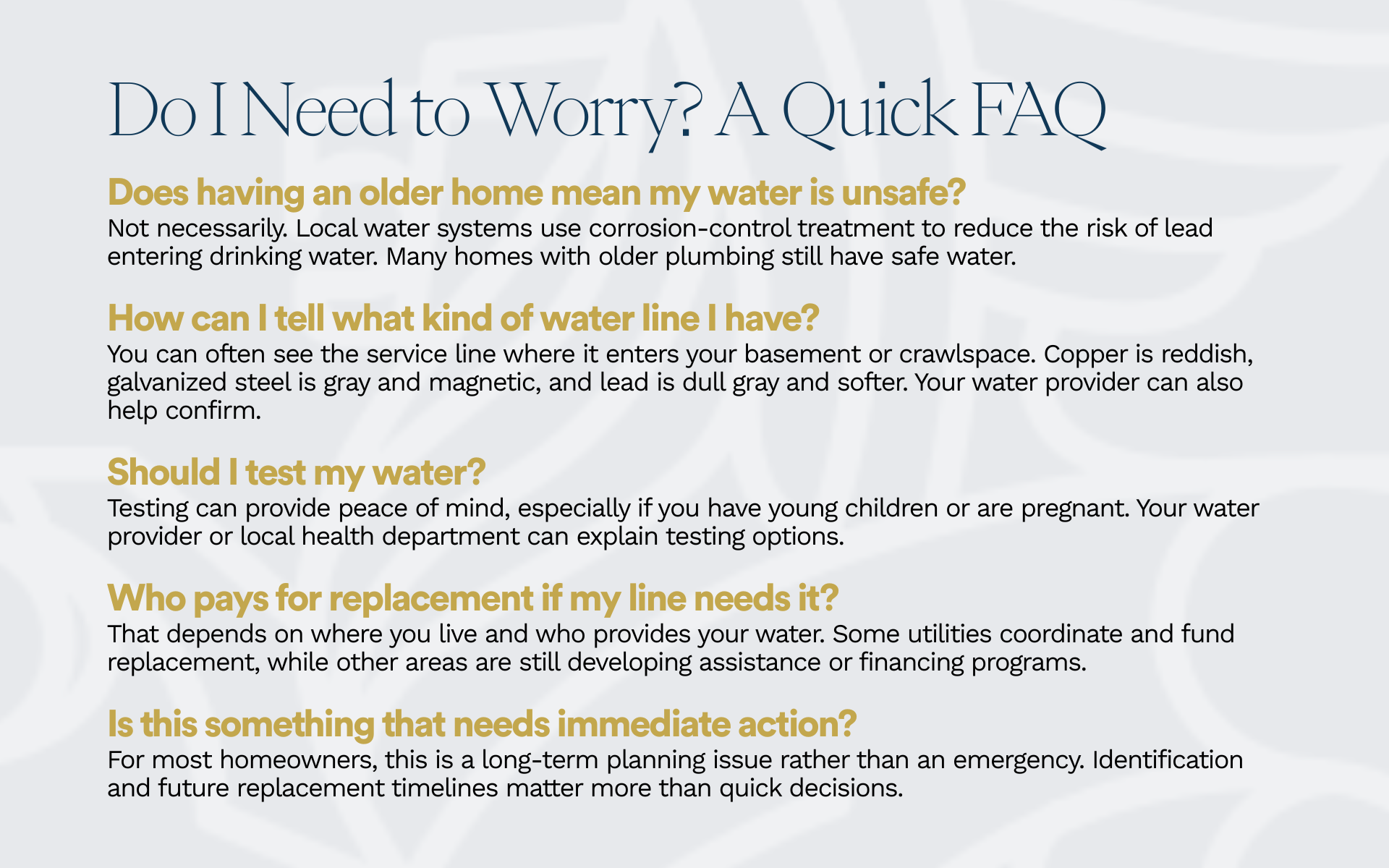
Even if a home has an older service line, it does not automatically mean unsafe drinking water. Local water systems use corrosion control to reduce risk. Still, homeowners who want additional peace of mind can take simple steps:
- Use cold water for drinking and cooking
- Flush taps that haven’t been used for several hours
- Consider water testing, especially in homes with young children or pregnant residents
What This Means for Buyers and Sellers
- Older homes may require extra questions during inspections
- Service line material is increasingly part of buyer due diligence
- Replacement programs and timelines vary widely depending on location and provider
Understanding who supplies water to a property — and what programs are available — can help set realistic expectations during a transaction.
The Bottom Line
St. Louis City and St. Louis County are taking different paths toward the same goal: identifying and replacing aging water service lines over time. While the work is ongoing, homeowners today can take practical steps to understand their own situation and prepare for future updates.
If you’re buying, selling, or maintaining an older home, knowing who to contact and how to verify your service line is an important part of informed homeownership. We’ve guided clients through this process before. Feel free to reach out with questions.